Jobimol Mathew, Lt. Col. (Dr.) Karesh Prasad, Priyanka Shukla. A Quasi-Experimental Study to Assess the Effectiveness of Pelvic Floor Exercises (Kegels Exercises) in Stress Urinary Incontinence Among Patients in Selected Private Hospitals, Bhopal City. 2026;5(3):19-21. Doi:10.65829/Rvcn2022.1032.

RV JOURNAL OF NURSING SCIENCES (RVJNS)
Volume 5 | Issue 3 | July-September 2026 | Pages: 19 - 21
Original Article
A Quasi-Experimental Study to Assess the Effectiveness of Pelvic Floor Exercises (Kegel Exercises) in Stress Urinary Incontinence Among Patients in Selected Private Hospitals, Bhopal City
Mrs. Jobimol Mathew, Lt. Col. (Dr.) Karesh Prasad2, Mrs. Priyanka Shukla3
ABSTRACT
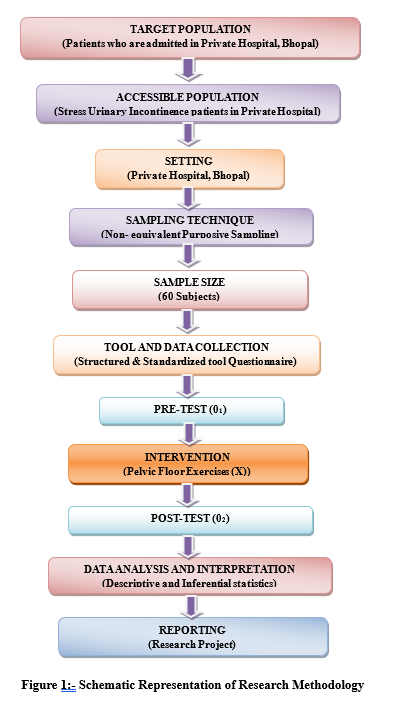
Urinary Incontinence (UI) is defined by the International Continence society as the complaint of any involuntary leakage of urine. Stress Urinary Incontinence (SUI) is the 2nd most common cause in aging females. It presents clinically as the involuntary loss of urine during physical activities that increase intraabdominal pressure, such as coughing or sneezing. A study was conducted to assess the effectiveness of Pelvic Floor Exercises (PFE) in SUI among 60 patients. A One Group Pre-Test Post-Test Design was utilized. Data were collected using the Incontinence Impact Questionnaire (IIQ-7) and analyzed by Descriptive and Inferential Statistics. Post-test results showed a significant decrease in the impact of SUI across all categories, with many patients reporting “not at all” or only “slight” interference in activities. The paired t-test values were statistically significant (p < 0.05) for every item. The findings conclude that PFE is highly effective in decreasing SUI among patients and is recommended as the best first-line treatment.
References
- David Gordon. Risk factors of Stress Urinary Incontinence. Journal of Urology. 20 (4): (2000). P 620-2.
- Mathews RJ. Stress urinary incontinence and its Management. Journal of Urogynaecology. 20(3): (2001). P 251-3.
- Gutman RE, Ford DE, et al. Is there a pelvic organ prolapse threshold that predicts pelvic floor symptoms? Obstetric & Gynecology. 2008;199:683.
- Jeffcoate. Principles of Gynaecology. 6th edition. Arnold publishers. (2000); pp 101-104.
- Scott B. Ransom. Principle strategies in Obstetrics and Gynaecology. (2001). pp 593-596.
- Newman DK. Urinary incontinence in women: acute and chronic management. Journal of Clinical Practice Guideline. 40: (2003). P 340-2.
- Olufunmilayo Ogundele. Women’s Health. 2nd ed. Saunders Publications; (2006) P 254-8.