


Sreekanth A. N, Rama Taneja. Digital Readiness and Telemedicine Preparedness Among Nursing Officers for Hypertension Care in a Tertiary Care Hospital, Bengaluru: A Cross-Sectional Analytical Study. 2026;5(3):11-18. doi:10.65829/rvcn2022.1030.
RV JOURNAL OF NURSING SCIENCES (RVJNS)
Volume 5 | Issue 3 | July-September 2026 | Pages: 10-18
Original Article
Digital Readiness and Telemedicine Preparedness Among Nursing Officers for Hypertension Care in a Tertiary Care Hospital, Bengaluru: A Cross-Sectional Analytical Study
Mr. Sreekanth A. N1, Dr. Rama Taneja2
ABCD - Index


GFMER

Crossref

SUDOC

ROAD

Copyright (c)

This work is licensed under a Creative Commons Attribution 4.0 International License
ABSTRACT
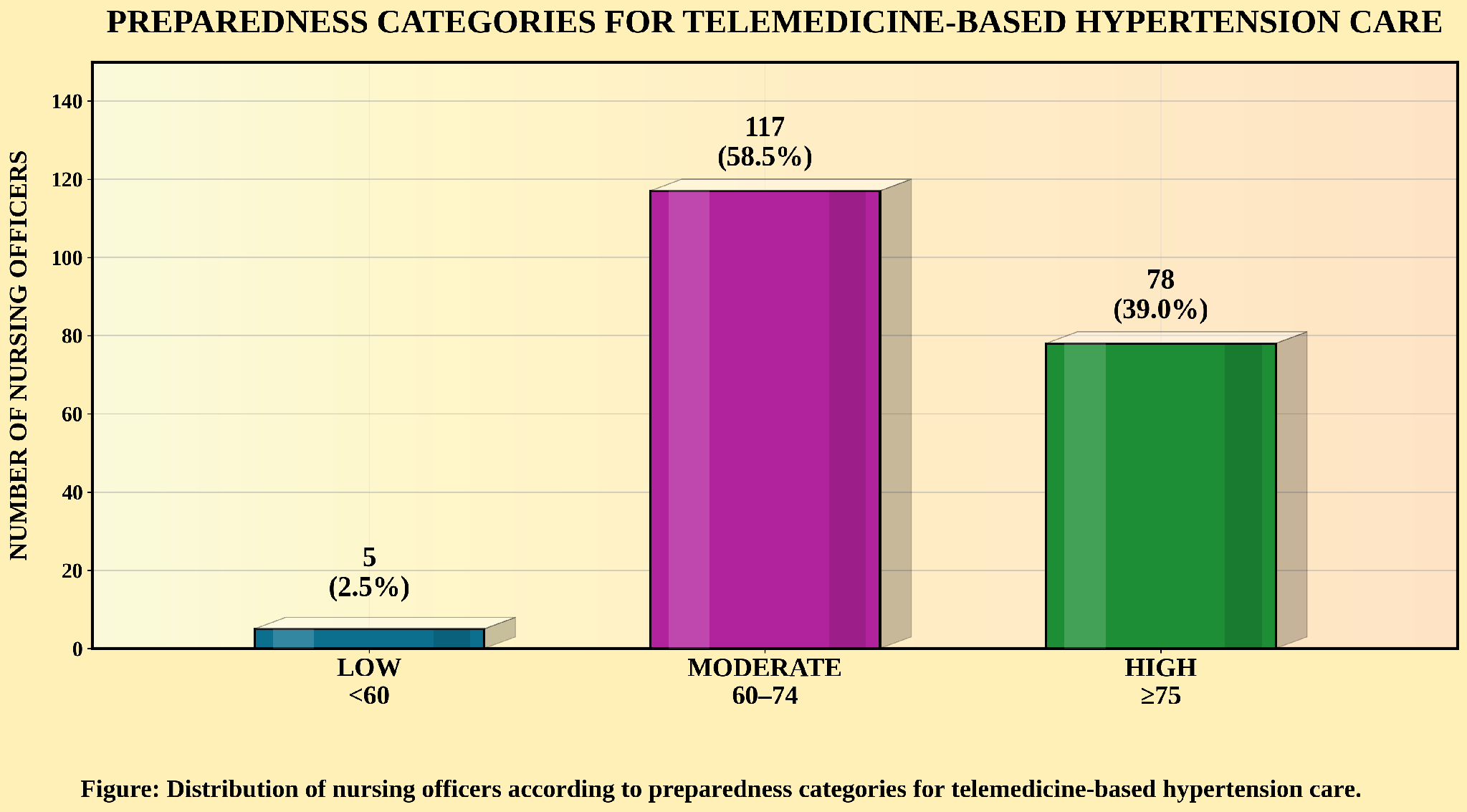
Background: Telemedicine can improve continuity of hypertension follow-up, but safe nurse-led virtual care requires digital access, eHealth literacy, communication confidence, privacy awareness, documentation skill, and timely referral preparedness.3,14,16 Objective: To assess digital readiness and telemedicine preparedness among nursing officers involved in hypertension care in a tertiary care hospital at Bengaluru, Karnataka.3,20 Methods: This cross-sectional analytical study included finalized data from 200 nursing officers. A 45-item Digital Readiness and Telemedicine Preparedness Inventory covering seven domains was scored on a 0-100 scale. High preparedness was defined as a total score of 75 or above. Descriptive tests, correlation, and multivariable logistic regression were used.8,10,20 Results: The mean total preparedness score was 73.08 (SD 6.15). High preparedness was observed in 78/200 participants (39.0%), moderate preparedness in 117/200 (58.5%), and low preparedness in 5/200 (2.5%). Digital access and infrastructure showed the highest domain mean (81.04), while documentation, privacy, and consent showed the lowest mean (65.27). Prior digital health/telemedicine training, routine digital clinical documentation, stable internet access, and higher eHealth information literacy independently predicted high preparedness.8,10,20 Conclusion: Nursing officers demonstrated moderate baseline readiness, with priority gaps in documentation, privacy, teleconsultation workflow, home BP review, and escalation. Targeted training and hospital workflow support are required before scale-up.8,11,19
References
- World Health Organization. Recommendations on digital interventions for health system strengthening. Geneva: World Health Organization; 2019.
- World Health Organization. Global strategy on digital health 2020-2025. Geneva: World Health Organization; 2021.
- World Health Organization. Consolidated telemedicine implementation guide. Geneva: World Health Organization; 2022.
- Board of Governors in supersession of the Medical Council of India. Telemedicine Practice Guidelines: Enabling Registered Medical Practitioners to Provide Healthcare Using Telemedicine. New Delhi: Ministry of Health and Family Welfare, Government of India; 2020.
- National Health Authority. Ayushman Bharat Digital Mission: Strategy overview and digital health ecosystem resources. New Delhi: Government of India; 2021.
- Sharma RS, Rohatgi A, Jain S, Singh D. The Ayushman Bharat Digital Mission (ABDM): making of India’s digital health story. CSI Transactions on ICT. 2023;11:3-9.
- Narayan A, Ghosh S, Sharma R. India’s evolving digital health strategy. npj Digital Medicine. 2024;7:1-8.
- Longhini J, Rossettini G, Palese A. Digital health competencies among health care professionals: systematic review. Journal of Medical Internet Research. 2022;24(8):e36414. doi:10.2196/36414. 17 https://doi.org/10.65829/rvcn2022.1030
- Alotaibi N, Wilson CB, Traynor M. Enhancing digital readiness and capability in healthcare: a systematic review of interventions, barriers, and facilitators. BMC Health Services Research. 2025;25:500. doi:10.1186/s12913-025-12663-3.
- Ibrahim YI, Sako SS, Ayele AA, Glagn MG, et al. Readiness of health professionals for telemedicine implementation: multi-centered cross-sectional study in public hospitals, South Ethiopia. Frontiers in Digital Health. 2025;7:1554199. doi:10.3389/fdgth.2025.1554199.
- Borges do Nascimento IJ, Abdulazeem H, Vasanthan LT, Martinez EZ, Zucoloto ML, Østengaard L, et al. Barriers and facilitators to utilizing digital health technologies by healthcare professionals. npj Digital Medicine. 2023;6:161. doi:10.1038/s41746-023-00899-4.
- Labrique A, Agarwal S, Tamrat T, Mehl G. WHO Digital Health Guidelines: a milestone for global health. npj Digital Medicine. 2020;3:120. doi:10.1038/s41746-02000330-2.
- Jandoo T. WHO guidance for digital health: what it means for researchers. 2020;6:2055207619898984. Digital Health. doi:10.1177/2055207619898984.
- Shimbo D, Artinian NT, Basile JN, et al. Self-measured blood pressure monitoring at home: a joint policy statement from the American Heart Association and American Medical Association. Circulation. 2020;142(4):e42-e63.
- Tucker KL, Sheppard JP, Stevens R, et al. Selfmonitoring of blood pressure in hypertension: a systematic review and individual patient data metaanalysis. PLoS Medicine. 2017;14(9):e1002389. doi:10.1371/journal.pmed.1002389. Volume 5 | Issue 3 | July -September 2026
- Bulto LN, Roseleur J, Noonan S, et al. Effectiveness of nurse-led interventions versus usual care to manage hypertension and lifestyle behaviour: a systematic review and meta-analysis. European Journal of Cardiovascular Nursing. 2024;23(1):21-32. doi:10.1093/eurjcn/zvad040.
- Margolis KL, Asche SE, Dehmer SP, et al. Comparing pharmacist-led telehealth care and clinic-based care for uncontrolled high blood pressure: the Hyperlink 3 pragmatic cluster-randomized trial. Hypertension. 2022;79(12):2708-2720. doi:10.1161/HYPERTENSIONAHA.122.19816.
- Moolsart S, Kritpolviman KM. Self-health monitoring by smart devices and ontology technology for older adults with uncontrolled hypertension: quasi-experimental study. JMIR Nursing. 2025;8:e73386. doi:10.2196/73386.
- Sreekanth AN, Taneja R. Effectiveness of videoassisted teaching on telemedicine competency among nursing officers for hypertension management in tertiary care hospitals at Bangalore Karnataka. RV Journal of Nursing Sciences. 2026;5(2):27-34. doi:10.65829/rvcn2022.1019.
- von Elm E, Altman DG, Egger M, Pocock SJ, Gøtzsche PC, Vandenbroucke JP. The Strengthening the Reporting of Observational Studies in Epidemiology (STROBE) statement: guidelines for reporting observational studies. PLOS Medicine. 2007;4(10): 10.1371/journal.pmed.0040296. e296. Doi: 10.1371/journal.pmed.0040296.