A Study to Assess the Knowledge regarding care of patients with intercostals drainage tube among staff nurses at selected hospital, Bangalore with a view to develop an information guide sheet."
Dr. Basavaraju G1, Mrs. Bhagyavathi2
Article history: Received 10 June 2025 Received in revised form 20 July 2025 Accepted 04 August 2025 Available online 10 October 2025
Basavaraju G, Bhagyavathi. A study to assess the knowledge regarding care of patients with intercostal drainage tube among staff nurses at a selected hospital, Bangalore, with a view to develop an information guide sheet. RV Journal of Nursing Sciences. 2025;4(4):24–27.
Copyright (c)
This work is licensed under a Creative Commons Attribution 4.0 International License
ABSTRACT
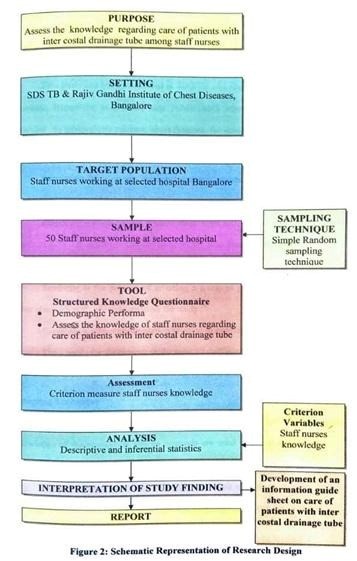
Competent nursing personnel are vital assets to the healthcare delivery system, particularly in providing safe, ethical, and quality care to patients. Caring for patients with an intercostal drainage (ICD) tube is a critical nursing responsibility that requires adequate knowledge and skill. Lack of awareness and competency in this area can lead to complications and poor patient outcomes. The present study aimed to assess the knowledge of staff nurses regarding the care of patients with ICD tubes at a selected hospital in Bangalore. A descriptive survey design was adopted, and data were collected using a structured knowledge questionnaire from 50 staff nurses selected through a simple random sampling technique at SDS TB and Rajiv Gandhi Institute of Chest Diseases, Bangalore. Descriptive and inferential statistics were used for analysis. The study findings revealed that the majority (40%) of respondents were between 40–49 years of age, 96% were females, and 78% were designated as staff nurses. A significant portion (58%) scored below the median knowledge level, indicating a knowledge deficit. The overall mean knowledge score was 68.63%. A statistically significant association was found between the area of working (χ² = 13.786, P = 0.003) and professional qualification (χ² = 6.004, P = 0.049) with knowledge scores, suggesting that nurses working in postoperative wards and ICUs, and those with higher professional qualifications, had better knowledge. Other demographic variables such as age, gender, designation, religion, general education level, and years of experience showed no significant association. The study concludes that there is a substantial need for regular in-service education and training programmes to enhance the knowledge and practice of nurses in managing patients with ICD tubes, thereby improving patient safety and quality of care.
References
Abruzzese, S. R., & Yoder Wise, P. (1992). Staff development: Our heritage, our visions. In United States Delmar Publishers (pp. 201-203).
Bastable, S. B. (2003). Nurse as educator: Principles of teaching and learning for nursing practice (2nd ed.). Jones and Bartlett Publishers.
Nettina, S. M. (2006). Lippincott manual of nursing practice (8th ed.). Lippincott Williams & Wilkins.
Gilbert, T. B., McGrath, B. J., &Sober man, M. (1993). Chest tubes: Indications, placement, management, and complications. Journal of Intensive Care Medicine, *8*(2), 73–86.
Smeltzer, S. C., & Bare, B. G. (2008). Brunner and Suddarth’s textbook of medical-surgical nursing (11th ed., Vol. 1). Lippincott Williams & Wilkins.
Smeltzer, S. C., & Bare, B. G. (2008). Brunner and Suddarth’s textbook of medical-surgical nursing (11th ed.). Lippincott Williams & Wilkins.
Davies, C. W. H., Gleeson, F. V., & Davies, R. J. O. (2003). Guidelines for the management of pleural effusion. Thorax, *58*(Suppl 2), ii18–ii20.